
Trump Threatens Fresh Iran Strikes as White House Warns Military Action Could Begin Within Days
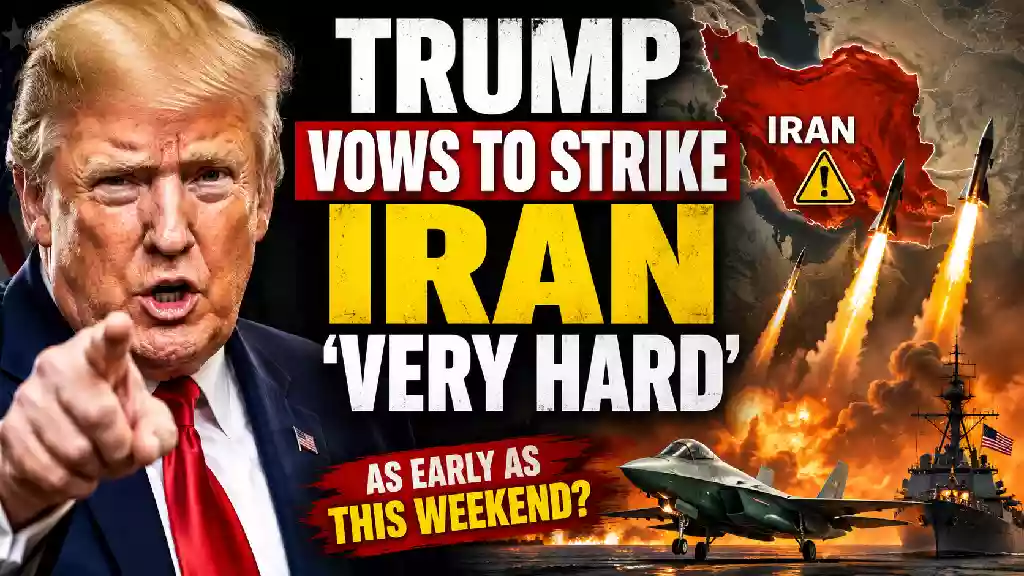
A YouTube thumbnail illustrating President Donald Trump's warning of possible military strikes against Iran, featuring missile launches, a U.S. Navy warship, fighter aircraft, and a highlighted map of Iran amid escalating Middle East tensions.
Trump Threatens Fresh Iran Strikes as White House Warns Military Action Could Begin Within Days
Trump Signals New Military Offensive Against Iran as US Prepares for Possible Escalation
President Donald Trump has renewed his warning to Iran, saying the United States is prepared to launch “very hard” military strikes if Tehran refuses to negotiate a deal to end the ongoing conflict. White House officials indicated that any new military operation could begin as early as this weekend, raising concerns that tensions in the Middle East may be entering a more dangerous phase.
The warning comes as Iran continues launching attacks against U.S. military bases across the region and threatens to target American and Israeli energy infrastructure if Washington authorizes another round of strikes. At the same time, the U.S. military has maintained pressure on Iran through ongoing naval operations, further intensifying an already volatile security situation.
White House Signals Potential Military Action
Speaking from New Jersey after holding a televised Cabinet meeting at Camp David, Trump suggested there is currently no clear end in sight to the conflict. According to the White House, any renewed military campaign could last several days if approved, with planning reportedly underway for multiple options.
The president compared the current military effort to previous prolonged U.S. conflicts, indicating that the administration remains committed to achieving its strategic objectives despite the possibility of an extended campaign.
Iran and U.S. Continue Escalating Military Pressure
As diplomatic tensions rise, the military standoff has continued to intensify.
According to the source material, U.S. Central Command (CENTCOM) has redirected approximately 30 vessels while maintaining a naval blockade aimed at limiting Iranian maritime operations. Meanwhile, Iranian officials have warned that additional American strikes could trigger attacks on U.S. and Israeli energy infrastructure, raising fresh concerns about regional stability and global energy security.
U.S. Embassy Issues Security Advisory
The growing uncertainty prompted the U.S. Embassy in Jerusalem to advise American citizens to reconsider travel to the region. Americans already in the area were urged to consider departing or be prepared to leave should security conditions deteriorate further.
The advisory reflects concerns that any new military operation could rapidly expand the conflict beyond its current scope.
Military Expert Outlines Alternative Strategy
During the interview, retired U.S. Air Force Brigadier General John Tykert argued that continuing to strike conventional military targets alone may not significantly influence Iran’s leadership.
Instead, he suggested the United States consider precision strikes against strategic infrastructure that supports the Iranian government’s financial and logistical capabilities. Among the locations discussed was Kharg Island, which Tykert described as a critical source of funding for the Iranian regime. He argued that carefully targeted operations against such assets could place greater pressure on the government without requiring American ground forces.
Debate Continues Over Civilian Risks
The proposal to target infrastructure has also sparked questions about the potential humanitarian consequences.
During the discussion, concerns were raised over whether attacks on energy facilities or power infrastructure could affect civilians. Tykert responded that any military operation should focus on carefully selected strategic targets associated with the regime rather than widespread attacks that could unnecessarily impact the civilian population.
Ground Troops Remain an Unlikely Option
The interview also addressed the possibility of deploying U.S. ground forces inside Iran.
Tykert described such an operation as a high-risk scenario and argued that precision airstrikes against strategic targets should be exhausted before considering any ground deployment. He maintained that weakening the regime’s financial and logistical capabilities could prove more effective than committing American troops to combat operations inside Iranian territory.
Israel-Hamas Negotiations Continue Alongside Iran Crisis
Even as tensions with Iran continue to dominate headlines, diplomatic efforts involving Israel and Hamas remain active.
According to the source material, Trump said the United States and Israel are aligned on a proposal that would involve Hamas surrendering its weapons in exchange for an Israeli withdrawal from Gaza. Secretary of State Marco Rubio also described Hamas disarmament as a significant step toward reducing violence in the region.
Middle East Faces Critical Days Ahead
With military forces remaining on alert and diplomatic efforts showing limited progress, the coming days may prove pivotal for the region.
The White House has indicated that military action remains under consideration, while Iran continues issuing warnings of retaliation. At the same time, security advisories for American citizens underscore growing concerns that the conflict could widen if negotiations fail.
Whether the situation moves toward renewed diplomacy or additional military action, developments in the coming days are expected to have significant implications for regional security, international energy markets, and broader geopolitical stability.
#DonaldTrump #Trump #Iran #TrumpIran #IranNews #MiddleEast #MiddleEastConflict #USMilitary #BreakingNews #WorldNews