
Oklahoma Governor’s Race Heads to Runoff as Drummond and Mazzei Advance Munson Claims Democratic Nomination
Oklahoma Governor’s Race Heads to Runoff as Drummond and Mazzei Advance Munson Claims Democratic Nomination
Oklahoma Election Results Set Stage for Key Runoff Contests
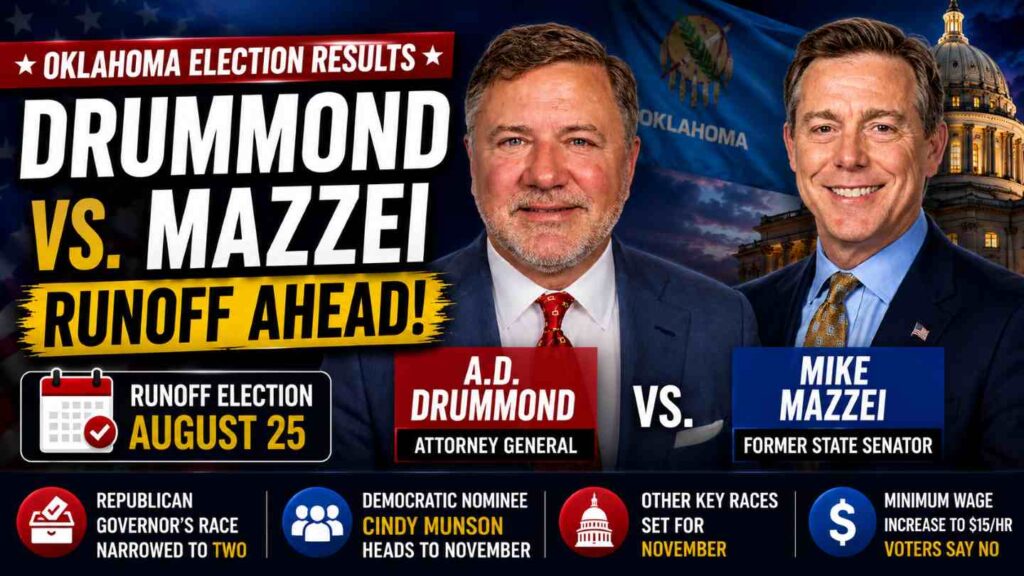
Oklahoma voters narrowed the field in several high-profile statewide races Tuesday, sending the Republican gubernatorial contest to a runoff while Democratic candidate Cindy Munson secured her party’s nomination for governor.
The election results also shaped races for lieutenant governor, U.S. Senate, and state superintendent, while voters rejected a ballot measure that would have gradually increased Oklahoma’s minimum wage to $15 per hour.
Attorney General A.D. Drummond and former State Senator Mike Mazzei emerged as the top finishers in the Republican primary for governor, setting up a closely watched runoff election scheduled for August 25. Neither candidate received enough support to secure the nomination outright, forcing the race into an additional round of voting.
Drummond and Mazzei Advance in Republican Governor Primary
The Republican race for governor attracted significant attention as candidates competed to become the party’s nominee in one of Oklahoma’s most important elections.
Drummond, who currently serves as Oklahoma Attorney General, benefited from strong statewide name recognition and a record in public office. Mazzei, a former state senator and financial consultant, entered the race with substantial support from conservatives and received a high-profile endorsement from President Donald Trump in the days leading up to the election.
As results were reported, both candidates emerged as clear frontrunners, earning spots in the August runoff. The winner will advance to the November general election and face Democratic nominee Cindy Munson.
Political observers expect the runoff campaign to focus on economic growth, education, public safety, and the future direction of state government.
Cindy Munson Secures Democratic Nomination
On the Democratic side, State Representative Cindy Munson won her party’s nomination in convincing fashion, avoiding a runoff and earning a place on the November ballot.
Munson’s victory allows her campaign to shift its attention toward the general election months earlier than her Republican opponents, who must continue campaigning through the summer runoff.
As one of Oklahoma’s most prominent Democratic leaders, Munson is expected to focus her campaign on issues including education, healthcare, economic opportunity, and government accountability.
TW Shannon Wins Republican Lieutenant Governor Nomination
The race for lieutenant governor produced a decisive outcome as former Oklahoma House Speaker T.W. Shannon secured the Republican nomination without the need for a runoff.
Despite facing multiple opponents, Shannon earned enough support to advance directly to the general election. He will face Democratic candidate Kelly Forbes in November.
The lieutenant governor’s race is expected to focus on economic development, business growth, and support for Oklahoma communities.
Kevin Hern Advances in US Senate Contest
Republican Congressman Kevin Hern also scored a significant victory, winning his primary contest and advancing to the November general election in the race for the U.S. Senate.
Hern emphasized his commitment to representing Oklahoma’s conservative values in Washington and advocating for policies designed to strengthen the state’s economy and competitiveness.
On the Democratic side, Mikayla Jasmine Thompson-Thomas and Jim Priest will compete in a runoff election to determine who will face Hern in November.
The Senate race is expected to attract national attention as candidates debate federal spending, border security, energy policy, and economic growth.
State Superintendent Race Moves Toward Summer Runoff
Oklahoma’s race for State Superintendent of Public Instruction also produced a mix of clear winners and unresolved contests.
Former Tulsa Public Schools Board of Education member Dr. Janetta Marshall secured the Democratic nomination and will advance directly to the general election.
Republican voters, however, will return to the polls after no candidate achieved the majority required to win outright.
Hall of Fame educator Dr. Robert Franklin finished first in the Republican primary, while educator and pastor Dr. James Taylor secured the second runoff position. The two candidates will compete in August to determine the Republican nominee.
Education policy, teacher retention, school funding, and student achievement are expected to remain central issues throughout the campaign.
Minimum Wage Increase Proposal Rejected
One of the most closely watched ballot measures of the election was State Question 832, which sought to raise Oklahoma’s minimum wage to $15 per hour.
The proposal failed to receive enough support from voters, meaning the state’s current wage structure will remain in place.
Supporters of the measure argued that a higher minimum wage would help working families cope with rising costs and improve economic security. Opponents contended that the increase could place additional burdens on businesses and reduce Oklahoma’s competitive advantages.
Although the proposal was defeated, advocates say the campaign succeeded in generating discussion about wages, worker compensation, and the cost of living across the state.
Looking Ahead to November
With several major races now heading toward runoff elections, Oklahoma’s 2026 political season remains highly active. The August 25 runoff contests will determine key nominees and shape the November general election ballot.
As campaigns intensify in the months ahead, voters can expect continued debate over economic policy, education, workforce development, public safety, and the future direction of Oklahoma government.
#OklahomaElection #ElectionResults #ADDrummond #MikeMazzei #CindyMunson #KevinHern #TWShannon #OklahomaPolitics #RunoffElection #StateQuestion832