
Ro Khanna Calls for Supreme Court Reform Backs 18 Year Term Limits and Court Expansion
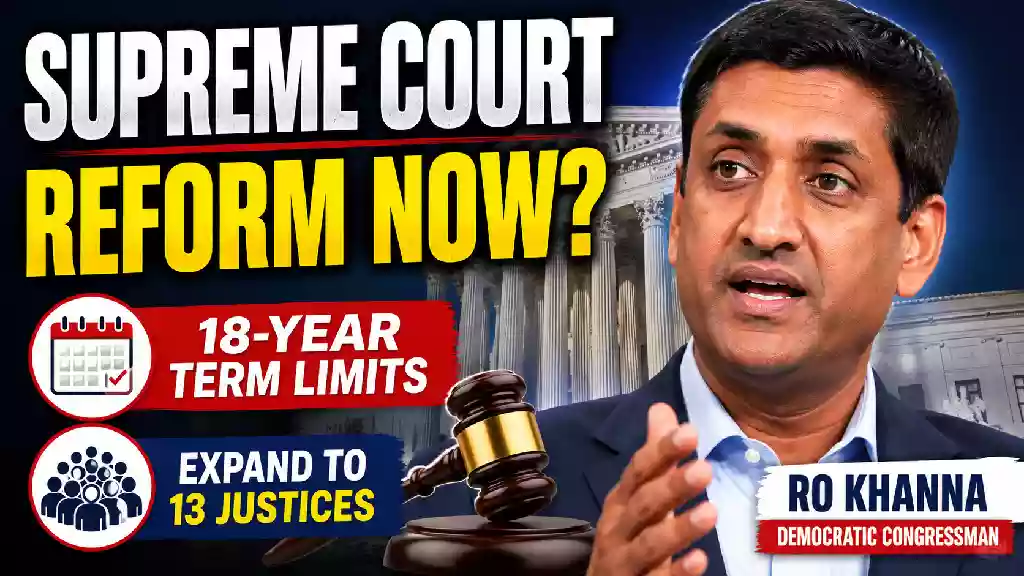
Ro Khanna Calls for Supreme Court Reform Backs 18 Year Term Limits and Court Expansion
Democratic Congressman Calls for Common-Sense Reforms to Modernize the Nation’s Highest Court
Democratic Congressman Ro Khanna is renewing his call for major reforms to the U.S. Supreme Court, arguing that changes such as term limits for justices and expanding the size of the court would improve public confidence and better reflect the needs of a modern democracy.
Speaking during a recent interview, Khanna defended proposals that have become increasingly prominent within some political circles, while emphasizing that judicial independence must remain intact.
The California lawmaker said his approach represents “common-sense bipartisan reform” rather than an attempt to politicize the judiciary.
Khanna Advocates 18-Year Term Limits
One of Khanna’s primary proposals is imposing 18-year term limits on Supreme Court justices.
Currently, Supreme Court justices serve lifetime appointments under the Constitution. Khanna argues that lengthy tenures can create an imbalance in the judicial system and make appointments increasingly contentious.
Under his proposal, justices would serve on the Supreme Court for 18 years before transitioning to senior status, where they could continue serving within the federal judiciary on appellate courts.
Khanna noted that many justices serve for decades, sometimes remaining on the bench for 30 to 40 years or longer. He believes a structured term system would create a more predictable appointment process while preserving judicial expertise.
The congressman also expressed support for term limits on members of Congress and U.S. senators, arguing that regular turnover can strengthen democratic institutions.
Proposal Would Expand Court to 13 Justices
Khanna also voiced support for increasing the size of the Supreme Court from its current nine members to 13 justices.
The proposal is tied to the federal court system’s 13 judicial circuits. Khanna argued that aligning the number of Supreme Court justices with the number of circuit courts would better reflect the nation’s legal framework.
He emphasized that his proposal is not intended as a partisan effort to reshape the court. Instead, he suggested a structured appointment process in which every president would receive two Supreme Court appointments.
According to Khanna, such a system could reduce political battles surrounding vacancies and provide a more balanced approach to judicial appointments over time.
Supporters of court expansion argue that the judiciary should evolve alongside the nation’s growing population and increasingly complex legal system. Critics, however, warn that increasing the number of justices could further politicize the court and erode public trust.
Debate Continues Over Constitutional Authority
Questions remain regarding whether Congress could enact all aspects of Khanna’s proposal without a constitutional amendment.
Khanna argued that Congress clearly possesses the authority to alter the size of the Supreme Court, noting that lawmakers have changed the court’s membership several times throughout American history.
He pointed to the period during President Abraham Lincoln’s administration when the number of justices was expanded.
The issue of term limits remains more legally complex. Khanna maintains that term limits could be implemented through legislation because justices would retain lifetime judicial status even after leaving the Supreme Court.
Constitutional scholars remain divided on whether such a plan could withstand legal challenges, ensuring that the debate is likely to continue.
Addressing Concerns About Judicial Independence
Critics of Supreme Court reform frequently argue that changing the court’s structure could undermine judicial independence.
Khanna rejected that claim, saying reform should not be viewed as an attack on the judiciary. Instead, he argued that carefully designed changes could strengthen public confidence in the institution while preserving its constitutional role.
The congressman stressed that judicial independence remains essential to American democracy and said any reform effort should be designed to protect the court from partisan influence.
Recent Supreme Court rulings on major national issues have intensified debate about the court’s role and sparked renewed calls for reform from lawmakers, activists, and legal scholars across the political spectrum.
Khanna Defends Engagement Across Political Platforms
The interview also touched on Khanna’s appearances on a variety of media platforms, including programs hosted by controversial political commentators.
Khanna defended engaging with audiences across the political spectrum, arguing that democracy requires elected officials to participate in conversations with people who hold different viewpoints.
While acknowledging disagreements with certain commentators and public figures, he said politicians should be judged by their own positions and policy proposals rather than the platforms where they choose to communicate.
The congressman reiterated his opposition to terrorism and emphasized the importance of open dialogue in a democratic society.
Supreme Court Reform Likely to Remain a Major Political Issue
As the nation continues to debate the future of the judiciary, Khanna’s proposals highlight the growing discussion surrounding Supreme Court reform.
Whether through term limits, court expansion, or other structural changes, lawmakers on both sides of the political spectrum are increasingly grappling with questions about how the nation’s highest court should function in the decades ahead.
With public attention focused on the judiciary’s role in shaping national policy, the conversation surrounding Supreme Court reform shows little sign of fading.
#RoKhanna #SupremeCourt #SupremeCourtReform #JudicialReform #TermLimits #CourtExpansion #USPolitics #Congress #LegalNews #BreakingNews