
Chinese Hackers Target US Senate DOJ and NASA in Cyber Espionage Operation
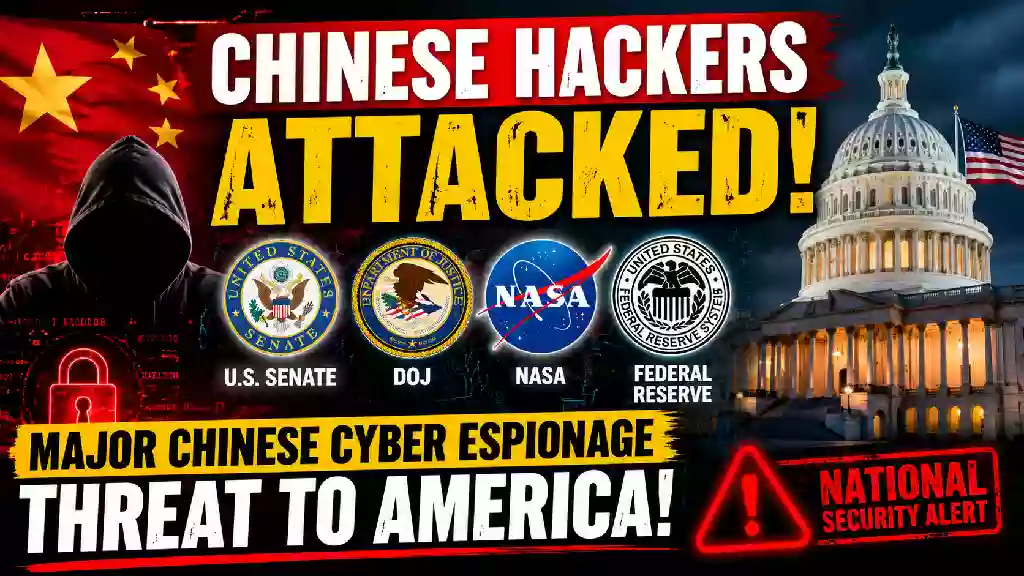
U.S. officials warn of a major Chinese cyber espionage threat after an alleged hacking operation targeted the U.S. Senate, Department of Justice, NASA, Federal Reserve and other critical U.S. networks.
Chinese Hackers Target US Senate DOJ and NASA in Cyber Espionage Operation
Chinese Cyber Espionage Operation Targets US Senate DOJ and NASA
A suspected Chinese cyber espionage campaign targeting sensitive U.S. government networks has raised fresh national security concerns after the Justice Department announced that authorities had disrupted a hacking operation linked to Chinese interests.
The reported operation allegedly reached multiple high-value American targets, including the U.S. Senate, Department of Justice, NASA and Federal Reserve, while also extending to other government agencies, military networks, hospitals and critical infrastructure.
Justice Department Moves Against Alleged Hacking Network
The Justice Department is reportedly on heightened alert after uncovering and disrupting what officials described as a major Chinese cyber espionage network.
According to the supplied report, the activity was characterized as state-sponsored cyber activity and a significant national security concern. Hackers were reportedly linked to Chinese military and intelligence services and allegedly used a private company to disguise or facilitate their cyber operations.
The alleged campaign illustrates the growing difficulty of protecting government networks against sophisticated foreign cyber operations. Rather than focusing on a single agency, the reported activity involved a wide range of organizations with access to sensitive government, financial, scientific and infrastructure information.
U.S. Senate, NASA and Federal Reserve Among Reported Targets
The scope of the reported cyber operation is particularly significant because of the institutions named as potential targets.
The source identifies the Department of Energy, Department of Justice, Department of Health and Human Services, National Institutes of Health, NASA, Federal Reserve and U.S. Senate among the organizations targeted. American military networks, hospitals and power companies were also reportedly affected by the broader campaign.
Such targets are strategically important. Government agencies hold sensitive information, while financial institutions and critical infrastructure form the backbone of the U.S. economy and essential public services.
An intrusion into these systems could create consequences far beyond stolen information, particularly if attackers were able to interfere with operations or maintain long-term access.
Government Seizes Three Internet Domains
American authorities also took steps to disrupt the infrastructure allegedly connected to the cyber espionage operation.
The U.S. government reportedly seized three internet domains affiliated with the Chinese company accused of being used as a portal for cyber spying.
The move represents an effort to cut off digital infrastructure that investigators believe was connected to the alleged operation. However, officials remain concerned that cyber adversaries could attempt to rebuild their networks or launch new attacks.
The warning is straightforward: disrupting one cyber operation does not necessarily eliminate the broader threat.
China Has Repeatedly Denied U.S. Hacking Claims
There was reportedly no immediate response from the Chinese government following the latest U.S. action. The source notes that Chinese officials routinely deny American accusations involving China-based hacking activities.
The allegations come amid years of tension between Washington and Beijing over cyber espionage and national security. U.S. officials indicated that the issue has been discussed with Chinese counterparts repeatedly, with American authorities continuing to demand an end to such activity.
Artificial Intelligence Could Make Cyberattacks More Dangerous
Adding another layer to the security concerns is the rapid development of artificial intelligence.
Cybersecurity companies are reportedly warning that foreign adversaries could use AI to conduct increasingly sophisticated attacks against both public and private systems. Potential targets could include banks, water utilities, oil production, supply chains and other critical infrastructure.
The concern is that AI could allow malicious actors to make cyber campaigns faster, more scalable and potentially harder to detect.
The report also raises concerns that foreign cyber criminals are using Chinese AI models that may not include the same safeguards as American AI systems.
Washington Focuses on AI Cybersecurity
The growing AI threat comes as the Trump administration works with technology and cybersecurity industry leaders on new protections.
According to the supplied material, administration officials recently met with industry leaders to finalize a framework for evaluating the cybersecurity risks associated with advanced artificial intelligence models.
The effort reflects an increasingly urgent challenge for policymakers: ensuring that technological advances do not create new vulnerabilities that hostile governments or criminal organizations can exploit.
Cybersecurity Remains a National Security Priority
The reported hacking operation serves as another warning about the vulnerabilities facing U.S. government networks and critical infrastructure.
With the Senate, DOJ, NASA, Federal Reserve, military networks, hospitals and power companies reportedly among the targets, the incident demonstrates the broad range of systems that foreign cyber operations can potentially threaten.
While U.S. authorities disrupted the reported network, officials remain concerned that adversaries could return with new methods and infrastructure. The combination of state-sponsored cyber espionage and rapidly advancing artificial intelligence could make future attacks even more challenging to prevent.
For Washington, strengthening cybersecurity defenses, protecting critical infrastructure and establishing safeguards for advanced AI will remain essential parts of the national security strategy.
#ChineseHackers #ChineseCyberAttack #CyberEspionage #Cybersecurity #NationalSecurity #USSenate #DOJ #NASA #FederalReserve #China #CyberThreats #AICybersecurity