
Americans Without College Degrees Find New Jobs as AI Reshapes US Workforce
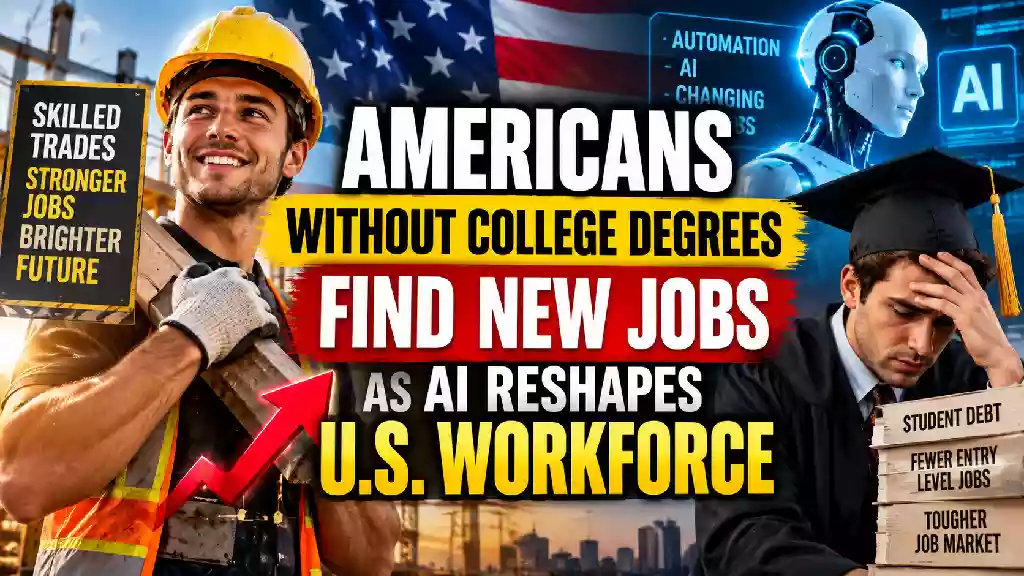
Americans without college degrees are finding new opportunities as skilled trades and AI-related infrastructure expand, while artificial intelligence reshapes traditional entry-level jobs across the U.S. workforce.
Americans Without College Degrees Find New Jobs as AI Reshapes US Workforce
Americans Without College Degrees Are Finding New Opportunities as AI Reshapes Work
For decades, Americans were often told that a four-year college degree was the clearest path to a successful career. But the changing U.S. labor market is challenging that assumption, as workers without college degrees are finding new opportunities while artificial intelligence begins to reshape traditional entry-level white-collar jobs.
New analysis highlighted in the source shows that unemployment among young Americans without college degrees has rarely been this low in recent decades. At the same time, some college graduates are facing a more difficult job market as companies increasingly turn to artificial intelligence to handle portions of entry-level and white-collar work.
The shift is putting renewed attention on skilled trades, technical careers and other occupations that do not require a traditional four-year degree.
The College Degree Debate Is Changing
The growing employment opportunities for workers without degrees do not necessarily mean that college has lost its value.
Instead, the issue is increasingly about cost versus return on investment. College graduates can benefit from higher education, but rising expenses and student debt have made the financial calculation more complicated for many families.
The source argues that the changing labor market should encourage Americans to look beyond the assumption that everyone must follow the same educational path.
For some students, a trade school, apprenticeship or technical program may offer a faster and less expensive route into a career.
AI Is Changing the First Step Into White-Collar Careers
Artificial intelligence is emerging as one of the biggest forces reshaping employment.
Companies are increasingly using AI to perform certain tasks that once required entry-level workers. That could create additional challenges for recent college graduates who traditionally relied on entry-level white-collar positions to begin their careers.
The development also highlights a major difference between today’s technology boom and earlier periods of disruption.
The source compares the current AI expansion with the aftermath of the dot-com bubble, when unemployment rose sharply across both blue-collar and white-collar jobs. This time, however, many workers in the skilled trades are benefiting from the infrastructure required to support the AI economy.
Data Centers Are Creating Demand for Skilled Workers
Artificial intelligence may be digital, but the infrastructure supporting it is very physical.
The expansion of AI requires massive data centers, electrical systems, construction projects and ongoing maintenance. Those facilities need skilled workers to build and operate them.
That means the AI boom can simultaneously put pressure on certain office jobs while increasing demand for workers in construction and technical trades.
This development is particularly significant for Americans who choose not to pursue a traditional college education. The source points to the strong demand for workers needed to build and maintain the infrastructure behind the AI industry.
Skilled Trades Are Gaining New Respect
For years, skilled trades were sometimes treated as a secondary option compared with college. That perception appears to be changing.
Electricians, technicians, construction workers and other skilled professionals can earn solid incomes while performing work that remains difficult to automate.
The growing recognition of these careers could encourage more young Americans to consider alternatives to a four-year university.
But there are important challenges. Trade jobs can be physically demanding, and workers may face significant strain on their bodies over time. The source specifically raises concerns about the long-term physical demands associated with some careers in the trades.
The Trades Need Better Career Pathways
Another important issue is what happens after workers enter the trades.
A successful workforce strategy cannot focus only on getting young people into entry-level trade positions. Workers also need opportunities to develop additional skills and move into leadership.
The source raises the need for stronger educational programs that can help workers progress from laborers to crew leaders, managers and eventually business owners.
Creating those pathways could make skilled trades more attractive as long-term careers rather than simply short-term alternatives to college.
Americans May Need to Rethink the Traditional Career Path
The broader lesson from the changing job market is that there is no single formula for career success.
What worked for one generation may not necessarily work the same way for the next. The source emphasizes that economic conditions change and that today’s young people should not automatically assume they need to follow the same path their parents or previous generations followed.
College can still be valuable, particularly for careers that require specialized academic credentials. But for others, technical training, apprenticeships and skilled trades may provide a more practical path.
A Changing Economy Is Creating New Choices
The American workforce is entering a period of significant change. Artificial intelligence is transforming parts of the white-collar economy, while construction, technical work and skilled trades are benefiting from the infrastructure needed to power new technologies.
For Americans without college degrees, that shift could create meaningful opportunities.
The future may not be about choosing between college and no college. Instead, it may be about choosing the education and training that provide the right skills, manageable costs and a realistic path toward long-term employment.
As the economy changes, flexibility may ultimately become one of the most valuable career skills of all.
Americans without college degrees, U.S. job market, skilled trades, trade school, AI and jobs, artificial intelligence, college degree, employment, blue collar jobs, white collar jobs, data centers, career opportunities, workforce trends, technical careers, college ROI