
Making a Difference – One Well at a Time Deep Fork 2.0 Reaches Well
well-done.jpg
Making a Difference – One Well at a Time Deep Fork 2.0 Reaches Well
The next phase of Deep Fork operations brings new crews, smarter processes, and a stronger commitment to protecting land while addressing abandoned wells.
Updates from Our Chairman: DEEP FORK 2.0
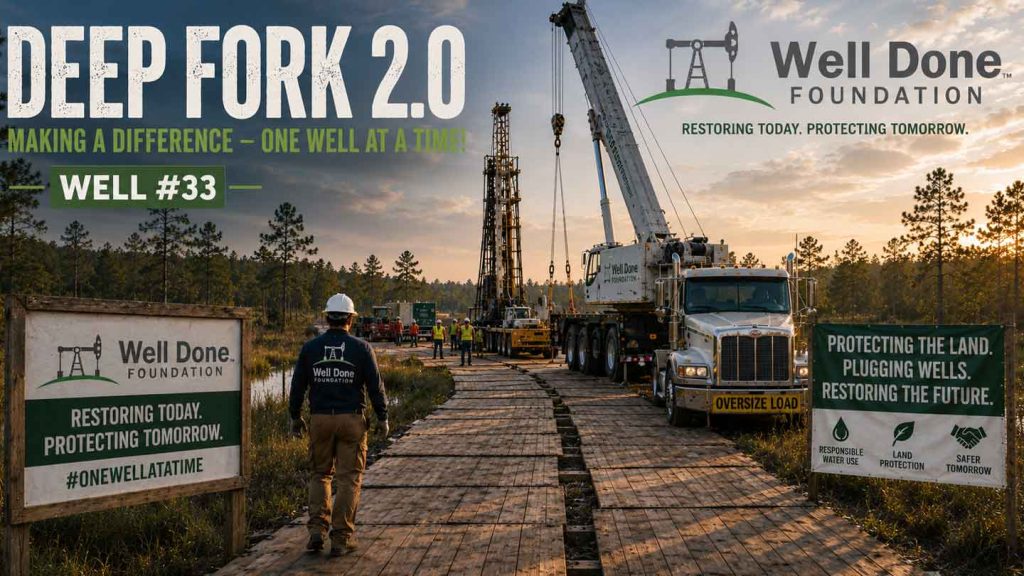
Last year, we set out to see what was possible in the Deep Fork National Wildlife Reserve in Oklahoma. In 12 months, we plugged 31 wells. Now we’re into what we’re calling Deep Fork 2.0—we’re already plugging well number 33! We learned a lot in that first year.
- How to better schedule prep work.
- How to move heavy equipment more efficiently.
- How to protect the land while we’re doing the job—and restore it when we’re done.
That learning is shaping how we move forward.
We launched our marine division to access offshore and underwater wells. Now we’re expanding the team again—adding a road crew to build access and lay down matting ahead of operations to protect soils and vegetation, and a pulling crew to move equipment and rigs safely from site to site.
We’ve brought in a new crane. We’re tightening up every part of the process.
We’re even tracking the water we use—making sure everything from wellbore cleaning to cement washout is handled the right way. Heck, we’re producing our own drilling mud to stay consistent with the standards required to operate in a wildlife refuge.
That’s what this next phase is about.
Doing the work more efficiently.
Doing it more responsibly.
And doing it at a scale that matches the problem.
This issue of the Good News Letter will give you a look at what’s ahead at Deep Fork—and how we’re getting it done.
#onewellatatime
— Curtis Shuck, Founder
The Carbon Wildcat
Building the Path: The Work Before the Work
Before a well is plugged, there’s another job that has to be done — getting there.
At Deep Fork and other sensitive sites, there are no roads leading to these wells. Access has to be built carefully, and more importantly, it has to be built without damaging the land.
That starts with matting.
When equipment moves into the field, rows of eight-by-fourteen-foot mats – resembling wood pallets – are laid down one by one to create a stable surface for trucks, rigs, and crews. Hundreds are often required. At the Hodge 8 well alone, more than 375 mats were used to protect the ground while plugging operations moved forward.
To support this work, WDF is expanding its field teams.
A new Road Crew is responsible for scouting routes, preparing terrain, and laying matting ahead of operations—setting the stage so work can proceed safely and efficiently. Following them, the Pulling Crew handles the movement of heavy equipment from one site to the next, keeping operations moving as each well is completed.
This is the work most people never see—but it’s essential.
Because in places like Deep Fork, the job doesn’t start when the rig shows up.
It starts when the first mat hits the ground.
And doing it right ensures everything that follows can be done the same way.