
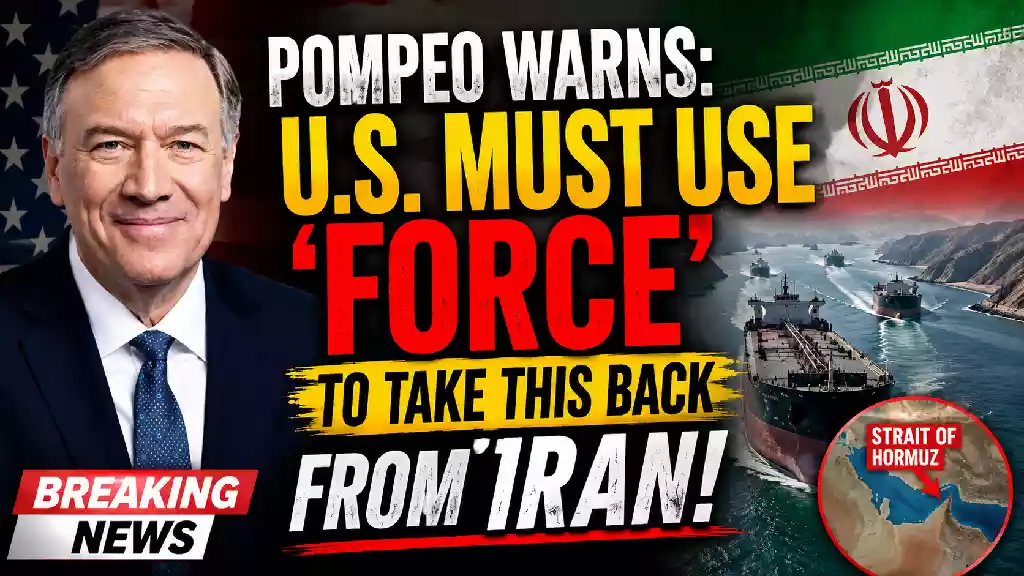
Mike Pompeo Doubts Iran Will Honor Strait of Hormuz Deal Calls for Firm US Response
Mike Pompeo Says Iran Cannot Be Trusted on Strait of Hormuz as Doha Talks Resume
Former Secretary of State and former CIA Director Mike Pompeo is casting doubt on the prospects of renewed U.S.-Iran diplomacy, warning that Tehran is unlikely to change its long-standing policies despite ongoing negotiations in Doha. Speaking during a televised interview, Pompeo argued that recent Iranian statements regarding the Strait of Hormuz demonstrate that the regime has no intention of allowing unrestricted international access to one of the world’s most critical shipping routes.
Iran’s Position Raises Concerns Before Doha Talks
As U.S. and Iranian officials prepare for another round of diplomatic discussions in Doha, questions remain about whether the negotiations can produce meaningful progress. Pompeo said dialogue is worthwhile but warned against expecting a dramatic shift in Iran’s approach after decades of hostility toward the United States and its allies.
Drawing on his experience as Secretary of State and CIA Director, Pompeo argued that Iran’s leadership has consistently pursued policies rooted in its revolutionary ideology and has shown little willingness to alter its strategic objectives. He cautioned that optimism surrounding the talks should be tempered by the regime’s historical actions rather than its diplomatic rhetoric.
Pompeo Challenges Iran’s Claims Over the Strait of Hormuz
The discussion centered heavily on the Strait of Hormuz after Iranian officials outlined their expectations for managing the vital waterway.
Iranian Foreign Minister Abbas Araghchi stated that navigation through the strait would return to normal under Iranian management following implementation of a Memorandum of Understanding between Tehran and Washington. Meanwhile, Iran’s Islamic Revolutionary Guard Corps (IRGC) has continued issuing warnings that commercial vessels should seek authorization when passing through certain areas near Iranian waters.
Pompeo said those statements appear inconsistent with the principle of free navigation through international waters. He argued that if Iran insists on controlling commercial transit, it would undermine the purpose of any agreement intended to keep the waterway open for global shipping.
Freedom of Navigation Remains a Strategic Priority
According to Pompeo, ensuring unrestricted access to the Strait of Hormuz should remain a central objective of U.S. foreign policy.
He argued that Iran views control of the strait as both an economic and military advantage and predicted the regime would not voluntarily relinquish that leverage. Pompeo warned that if diplomatic efforts ultimately fail, the United States may eventually face difficult decisions about how to guarantee freedom of navigation for international commerce.
Different Views on the Future of U.S.-Iran Relations
The interview also highlighted differing opinions within the U.S. government regarding engagement with Iran.
Vice President JD Vance has suggested that current communications between senior officials from both countries represent a significant departure from previous decades, raising hopes that diplomacy could succeed where earlier efforts struggled.
Pompeo disagreed with that assessment, saying increased communication does not necessarily signal a fundamental change in Iran’s leadership or long-term objectives. He maintained that policymakers should judge Tehran by its actions rather than its diplomatic messaging.
Why the Strait of Hormuz Is So Important
The Strait of Hormuz remains one of the world’s most strategically significant maritime corridors, serving as a gateway for a substantial share of global oil and liquefied natural gas exports. Any disruption to commercial traffic through the narrow waterway has the potential to affect international energy markets, shipping costs, and global economic stability.
Because of its strategic importance, military tensions or restrictions on navigation can have consequences well beyond the Middle East, making developments in the region closely watched by governments and financial markets worldwide.
Regional Tensions Continue to Shape the Debate
Pompeo also pointed to recent attacks involving U.S. military facilities in the Gulf region as evidence that tensions remain elevated despite diplomatic outreach. He noted that previous strikes caused significant damage to American military infrastructure, reinforcing concerns about regional security.
As negotiations continue in Doha, officials face the challenge of balancing diplomacy with deterrence. Whether the latest talks lead to measurable progress remains uncertain, but the future of the Strait of Hormuz and broader U.S.-Iran relations will continue to play a central role in Middle East security and global energy markets.