

Powerful 7.8 Earthquake Strikes Southern Philippines, Leaving Dozens Dead and Hundreds Injured
Powerful 7.8 Earthquake Strikes Southern Philippines, Leaving Dozens Dead and Hundreds Injured Strong Offshore Quake Triggers Tsunami Waves, Landslides and Widespread Damage Across Mindanao Region
Powerful 7.8 Earthquake Strikes Southern Philippines, Leaving Dozens Dead and Hundreds Injured
Strong Offshore Quake Triggers Tsunami Waves, Landslides and Widespread Damage Across Mindanao Region
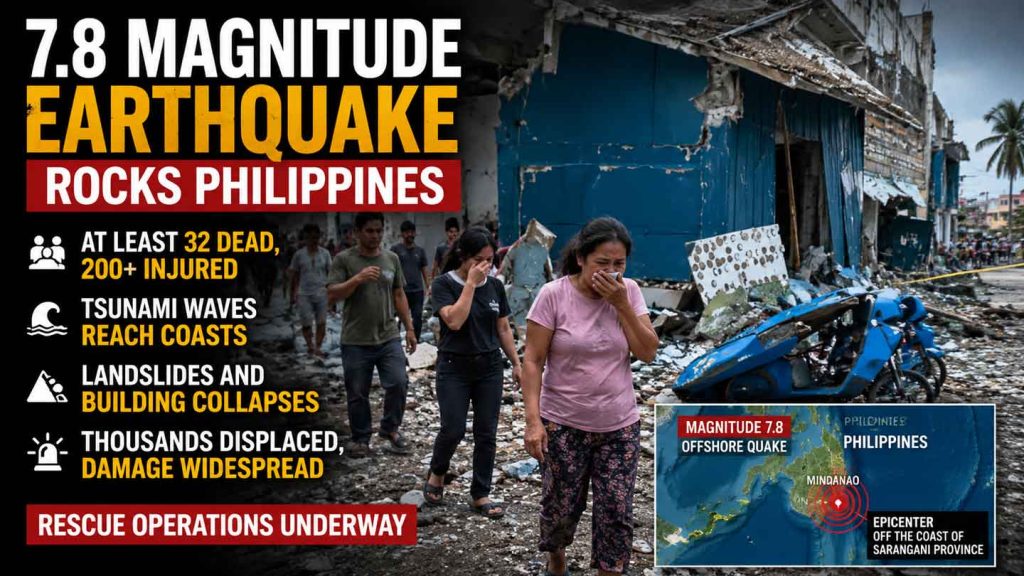
MANILA, Philippines — A powerful offshore earthquake measuring magnitude 7.8 struck the southern Philippines on Monday morning, leaving at least 32 people dead, more than 200 injured, and causing widespread destruction across several provinces.
The earthquake, one of the strongest to hit the country in recent years, generated tsunami waves, triggered deadly landslides, damaged infrastructure, and forced thousands of residents to flee their homes as emergency crews raced to assess the full extent of the disaster.
Authorities said the quake occurred off the coast of Mindanao, the nation’s second-largest island, sending strong shaking across much of the southern Philippines and neighboring countries.
Landslides and Building Collapses Cause Most Fatalities
Many of the reported deaths occurred when buildings collapsed or were struck by falling debris during the powerful tremor.
One of the hardest-hit areas was Sarangani Province, where a large landslide swept through homes in the mountainous municipality of Glan. Officials reported that at least 13 people lost their lives in the landslide, while several others were injured or displaced.
Additional fatalities were reported in General Santos City, South Cotabato, Davao Occidental, and other communities across southern Mindanao.
Emergency officials warned that the death toll could continue to rise as rescue operations progress and authorities reach remote communities impacted by the earthquake.
General Santos City Among Hardest Hit Areas
General Santos City, a major commercial and fishing hub in southern Philippines, experienced significant damage during the earthquake.
Several structures either collapsed or suffered major damage, including commercial buildings, warehouses, and residential properties. Search and rescue teams were deployed throughout the city to locate individuals who may have been trapped beneath debris.
Local officials reported that some students were feared trapped after a school building partially collapsed. Authorities also investigated reports of missing individuals as emergency responders continued their search efforts.
Residents described scenes of panic as the powerful shaking sent people rushing into streets and open areas.
Many businesses temporarily closed while engineers evaluated buildings for structural damage.
Tsunami Waves Reach Coastal Communities
The earthquake generated tsunami waves that struck several coastal communities along the southern Philippine shoreline.
Officials recorded waves reaching approximately one meter (three feet) in several areas, while one coastal location registered a wave measuring approximately 1.4 meters (4.6 feet).
Although the tsunami was relatively modest compared to some historic events, it still caused damage to homes, fishing structures, and coastal properties.
Several stilt houses located along the shoreline sustained damage from the combination of strong ground shaking and elevated water levels.
Tsunami waves were also detected in neighboring countries, including Indonesia and Palau, and were measured as far away as Japan.
The Pacific Tsunami Warning Center later announced that the primary tsunami threat had passed, and Philippine authorities lifted evacuation warnings later in the day.
Transportation and Public Services Disrupted
The powerful earthquake disrupted transportation and public services throughout the affected region.
General Santos International Airport temporarily suspended operations following the quake, leading to numerous flight cancellations and delays.
Roadways, bridges, and public infrastructure were inspected for damage as government agencies worked to restore normal operations.
Schools across the region were also impacted. Hundreds of students reportedly suffered minor injuries during evacuation efforts, while others were treated for shock and panic-related conditions.
The Philippine government ordered the cancellation of classes in affected areas to allow safety inspections and disaster response activities to continue.
President Marcos Orders Emergency Response
Philippine President Ferdinand Marcos Jr. directed national disaster-response agencies to immediately mobilize resources to the affected provinces.
Government officials coordinated rescue operations, medical assistance, damage assessments, and emergency shelter programs for displaced residents.
Marcos assured citizens that the national government would provide support to communities recovering from the disaster.
Emergency crews, military personnel, firefighters, and local officials continued working throughout the day to assist victims and assess structural damage across the region.
Aftershocks Continue to Threaten Recovery Efforts
Seismologists warned residents to remain cautious as powerful aftershocks continued to rattle parts of southern Philippines.
Several aftershocks measuring above magnitude 6.0 were recorded following the main quake.
Experts cautioned that already weakened buildings could collapse if subjected to additional seismic activity. Residents were urged to wait for official inspections before returning to damaged homes and businesses.
Disaster management officials emphasized the importance of following evacuation orders and remaining alert as recovery operations continue.
Philippines Remains Vulnerable to Natural Disasters
The Philippines is among the world’s most disaster-prone nations due to its location along the Pacific Ring of Fire, an area known for frequent earthquakes, volcanic eruptions, and tectonic activity.
In addition to seismic threats, the island nation regularly experiences powerful typhoons, flooding, landslides, and tropical storms.
Monday’s devastating earthquake serves as another reminder of the significant natural hazards faced by millions of Filipinos each year and highlights the ongoing need for disaster preparedness and resilient infrastructure throughout the region.