
Competing Republican factions test Oklahoma GOP unity!
Competing Republican factions test Oklahoma GOP unity
By Brooke Blach, Gaylord News
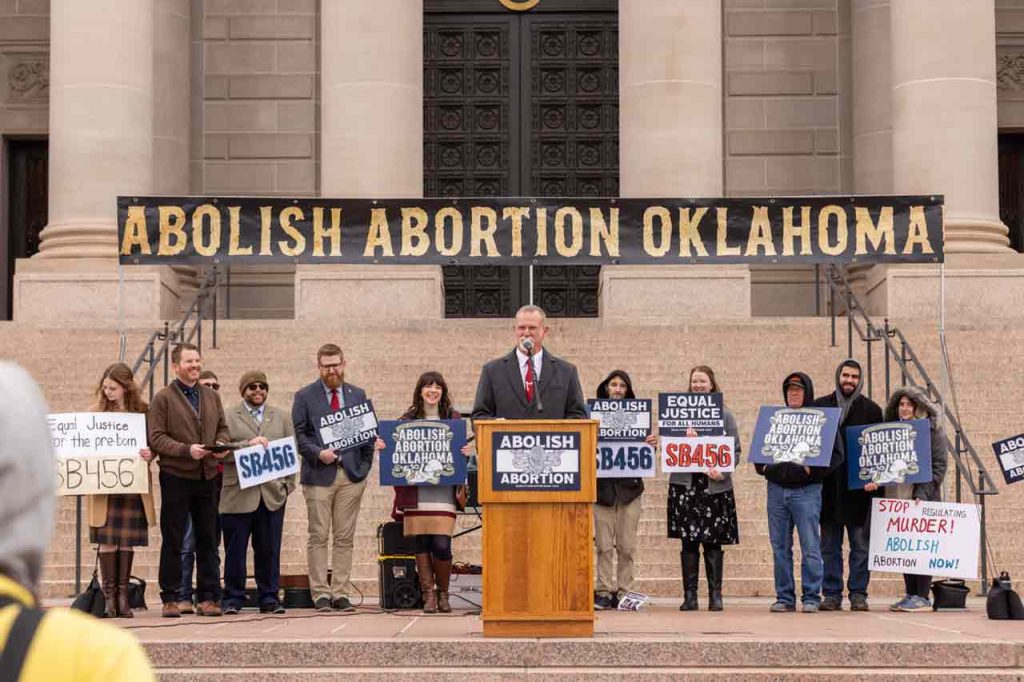
Republicans hold overwhelming power in Oklahoma politics, but some of the state’s most contentious political battles are happening within the party itself. From abortion legislation to disputes with Senate leadership, the disagreements have exposed competing views within the GOP over party leadership, legislative strategy and the direction of conservative policy. One of the most visible divisions has centered on the abortion abolitionist movement, which argues Oklahoma’s Republican leadership has not gone far enough to end abortion.
Although abortion is already banned in Oklahoma with limited exceptions, abortion abolitionists have pushed for the state to treat abortion as homicide and extend legal protection to unborn children from conception. That approach has created disagreement among Republicans over whether abortion laws should include criminal penalties for women. The divide became clear through Senate Bill 456, a 2025 proposal that attempted to put abolitionist principles into state law. Sen. Dusty Deevers, R-Elgin, authored the bill, which failed in the Senate Judiciary Committee after four Republican senators voted against it alongside the committee’s two Democrats. Deevers argued Oklahoma’s existing abortion laws fall short of what abolitionists consider equal protection for unborn children.
“You reference ‘Oklahoma’s strong pro-life laws’ but those laws fully permit a woman to order pills online and murder her children,” Deevers said. “I do not consider that a strong law. I consider it a suggestion with no teeth.” For Deevers, the disagreement is not over whether Republicans oppose abortion, but over how Oklahoma law should define and punish it. “The primary pushback is that many Republicans want to end abortion without providing any penalties for people who do it,” Deevers said. “But that’s just not how law works. If there is no penalty for murdering a child, then murdering children is simply legal.”
The disagreement extended beyond the legislature. The Foundation to Abolish Abortion reported that delegates at the Oklahoma Republican Party convention considered a resolution “condemning and censuring” Sens. Todd Gollihare, Darcy Jech, Paul Rosino and Brent Howard for voting against SB 456. The organization described the vote against the bill as a “blatant violation” of the party platform and said the resolution encouraged Republicans to “withhold all support from their political careers.”
A similar 2026 abolitionist proposal, House Bill 3038, did not advance in the House Criminal Judiciary Committee. Abolish Abortion Oklahoma blamed committee chairman Rep. Rande Worthen, R-Lawton, for blocking the bill and launched a campaign against him. In a March blog post on its website, the group said it raised money for billboards and door hangers portraying Worthen as “the man who kept abortion legal in Oklahoma.” When Worthen announced he would not seek reelection, he defended his decision not to hear the bill.
“I have been a supporter of every pro-life bill before the legislation during my time in office,” Worthen said. “But when their bill came before my committee which required charging girls as young as 13-17 years of age with murder, I knew I would not hear a bill that would require that result even when they were victims of rape or incest.” Seth McKee, a political science professor at Oklahoma State University, said the backlash reflects deeper factional divisions within the Oklahoma GOP. “When you have a state that evolves into such a strong one-party system, and then you don’t really have viable Democratic opposition, then the extreme is coming from within that single party that’s dominant,” McKee said.
Tony Lauinger, state chairman of Oklahomans for Life, said traditional anti-abortion organizations and abolitionists largely agree on the goal of ending abortion but differ on strategy. “I believe it’s fair to say the abolitionists place a bit more emphasis on the controlling-through-prosecution function of the law, whereas the traditional pro-life movement puts a bit more emphasis on the teaching function of the law,” Lauinger said.
The disagreements have extended beyond abortion, including disputes between the Oklahoma Freedom Caucus and Senate Republican leadership. During the final weeks of the legislative session, the caucus launched a series of social media posts criticizing Senate leadership after the regular session ended May 14, more than two weeks before the constitutional deadline. The posts focused on pending bills dealing with gun rights, immigration enforcement, education and criminal justice.
In one post, the caucus said Senate leadership had “epically failed the citizens of Oklahoma” after returning to work for only one day before adjourning. Similar disputes have surfaced among statewide officials. Gov. Kevin Stitt and Attorney General Gentner Drummond, a Republican candidate for governor, have exchanged public criticism in recent months over Medicaid oversight, government transparency and economic development.
In May, Stitt criticized Drummond’s request for an audit of the Oklahoma Health Care Authority, calling it “politically motivated.” Drummond fired back the same day, saying the governor and OHCA had chosen “to defend the insurance companies rather than the people they serve.” He said he would “leave the public to draw its own conclusions about why the governor is so determined to keep them from learning the truth.”
McKee said the disputes reflect the reality of Republican dominance in Oklahoma politics. “With such dominance of the Republican Party, it’s going to be factional in terms of who’s going to control the state,” McKee said. “So that’s what matters in terms of shaping politics in the state.” Gaylord News is a reporting project of the University of Oklahoma Gaylord College of Journalism and Mass Communication. For more stories by Gaylord News, go to GaylordNews.net
Cutline: Members of the Oklahoma Freedom Caucus, a coalition of Republican legislators that often pushes for more conservative policies than GOP leadership.