
Spain Immigration Crisis: Migrant Workers Fuel Agriculture as Anti-Migration Backlash Grows
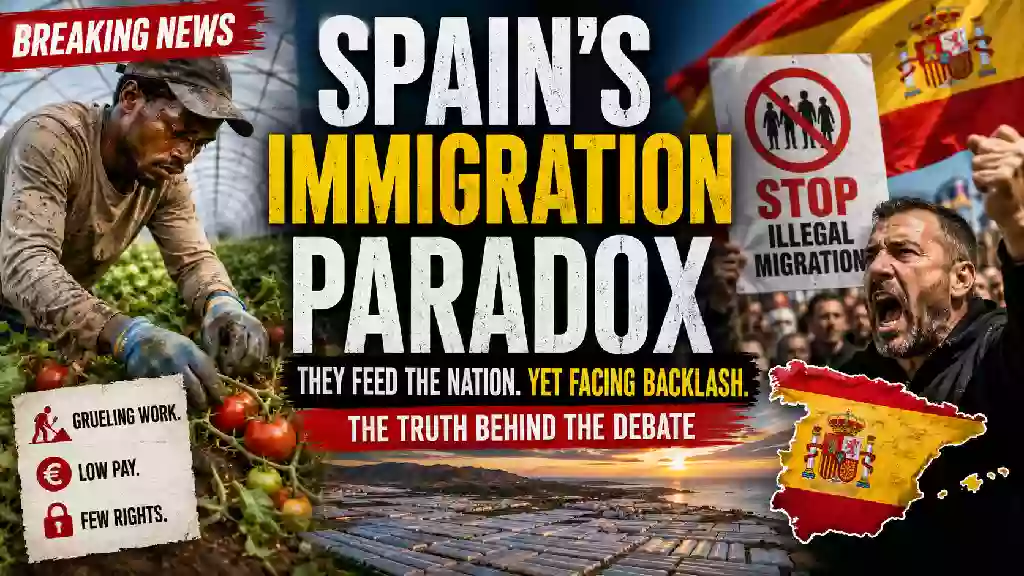
Spain’s immigration paradox: migrant workers play a major role in the country’s agricultural economy as anti-immigration sentiment continues to fuel debate over migration, labor and integration.
Spain Immigration Crisis: Migrant Workers Fuel Agriculture as Anti-Migration Backlash Grows
Spain’s Immigration Paradox: Migrant Workers Fuel the Economy as Anti-Migration Sentiment Grows
Spain is confronting a difficult contradiction at the heart of its immigration debate. Across the country, opposition to migration has intensified, while major industries continue to depend on foreign workers to fill demanding jobs. In southern Spain, particularly in Almeria, migrant labor has become deeply connected to the agricultural economy that supplies fresh produce to consumers across Europe.
The situation exposes a broader question facing Spain and Europe: how can countries manage migration and border pressures while protecting an economic system that increasingly depends on migrant workers?
Almeria’s Greenhouses Reveal the Contradiction
Almeria has become one of Europe’s most important agricultural regions, earning a reputation as a major source of fresh fruits and vegetables. Millions of tons of produce are grown across a vast landscape covered by greenhouses. Yet behind this highly productive agricultural industry is a workforce that includes thousands of migrants from North and West Africa.
Many migrant workers arrive in Spain after leaving difficult economic circumstances in their home countries. Their stories often involve enormous personal and financial risks.
Amweteng Foster, for example, was previously a mathematics teacher in Ghana. According to the source, he paid about $2,300 to smugglers for a dangerous journey through Libya and across the Mediterranean before reaching Spain. He said his goal was to earn enough money to provide a better future and help pay for his children’s education.
The Difficult Reality of Agricultural Work
For migrants who find employment, the journey does not necessarily lead to an easy life. Agricultural work in Almeria can be physically demanding, particularly inside greenhouses during the summer.
Workers spend hours planting and maintaining crops, including tomatoes, in tightly controlled greenhouse environments. Temperatures can become extreme, with the source reporting that conditions reached 44 degrees Celsius, or approximately 111 degrees Fahrenheit.
One worker described earning five euros for an hour of physically demanding work while kneeling and working continuously in the heat. While one greenhouse owner said his company only employs documented workers and pays the legal minimum wage, the situation is different for many undocumented migrants.
Across Almeria, undocumented workers reportedly gather at street corners and roundabouts hoping to be hired for informal jobs. Some of these positions pay significantly below the legal minimum wage, leaving vulnerable migrants exposed to exploitation.
Migrants Have Become Part of Spain’s Economic Story
The dependence on foreign labor extends beyond individual farms. The source notes that the arrival of migrant workers helped revive an area that had previously been in decline. Migrant communities have also become an established part of local society.
At the national level, Spain experienced a major increase in migration. The source states that more than three million migrants arrived between 2021 and 2023, describing it as the largest influx in the country’s history. It also cites the Bank of Spain as crediting immigration with a quarter of per-capita GDP growth during that period.
Spain’s economy also reportedly performed better than Germany, France and the United Kingdom following the pandemic, raising questions about whether its immigration and integration policies offer lessons for other European countries.
Anti-Immigration Politics Gains Ground
Despite the economic contribution of migrants, opposition to immigration is becoming increasingly visible.
In communities around Almeria, some residents have embraced the rhetoric of Spain’s populist radical-right party Vox. The source describes residents expressing support for migrants who are legally documented while portraying undocumented migration as an “invasion.” Concerns about demographic change and the rising cost of living have also contributed to growing anti-immigration sentiment.
The debate reflects a wider European struggle over immigration, integration and national identity. For many critics, the issue centers on border control and concerns about rapid demographic change. For businesses and industries dependent on foreign workers, however, migrants remain an important source of labor.
Poverty Drives Many Migrants to Spain
Behind the political arguments are individuals facing difficult economic circumstances.
Organizations assisting migrants report receiving constant requests for food, shelter and other forms of help. One woman from Morocco described leaving her young children behind and traveling to Spain under a contract to pick strawberries. After a dispute with her employer, she found herself without work and struggling to survive.
Her explanation was simple: poverty brought her to Spain.
That human dimension is often lost in the political debate. For some migrants, the decision to leave home is driven by the lack of economic opportunities rather than a desire to challenge Spain’s borders or social structure.
Spain Searches for a Sustainable Immigration Model
Spain’s experience illustrates the complicated relationship between migration and economic growth. The country needs workers in labor-intensive industries, while migrants need legal protections, decent working conditions and opportunities to integrate.
The source also notes that regularization efforts have been accelerating in 2026, as Spain attempts to address the presence of irregular migrants already in the country. At the same time, the rapid growth in population has raised questions about whether GDP per capita can keep pace with overall economic growth.
Spain’s immigration challenge therefore goes beyond the question of whether migrants should be welcomed or rejected. It is also about how a modern economy can meet its labor needs while maintaining effective immigration controls, protecting workers and addressing legitimate concerns within local communities.
The greenhouses of Almeria offer a powerful illustration of that dilemma. The workers harvesting Spain’s crops are essential to an industry serving millions of consumers, yet many remain among the country’s most vulnerable residents.
#Spain #SpainImmigration #MigrantWorkers #MigrantLabor #Almeria #SpanishAgriculture #Immigration #Migration #Europe #ImmigrationDebate